

The Science of Softness: Why Your Watch Box Lining Actually Matters
To the naked eye, a watch box interior is simple. It is "soft." It feels fuzzy. It seems safe. But to the serious horologist, "soft" is a scientifically imprecise term. In the world of microscopic interactions, not all soft materials are created equal. In fact, some of the most common materials used in budget storage solutions are secret enemies of a mirror-polished finish.
At BezelHold, we obsess over the physics of materials. We understand that preserving a luxury timepiece isn't just about cushioning it from a fall; it's about protecting it from the slow, invisible violence of micro-abrasion.
Here is the technical reality of why your watch box lining matters, and the science behind the BezelHold interior.
The Mohs Scale of Hardness: A "Geeky" Primer
To understand why watches scratch inside a box, we have to look at the Mohs Scale of Mineral Hardness. This scale ranks materials from 1 (very soft, like Talc) to 10 (very hard, like Diamond).
Here is where it gets interesting for collectors:
- 18k Gold: ~2.5 – 3.0
- 316L Stainless Steel: ~5.5 – 6.0
- Household Dust (Silica/Quartz): ~7.0
This is the "smoking gun." A significant portion of common household dust is composed of silica (sand) particles. Because silica (7.0) is harder than both Gold (3.0) and Steel (6.0), dust is technically an abrasive agent. It is essentially invisible sandpaper.
The Problem with Standard Felt and Wool
This brings us to the fatal flaw of standard felt or wool-based linings found in many watch boxes.
Felt is a non-woven cloth that is produced by condensing and pressing fibers together. Structurally, it is a chaotic tangle of fibers. This structure acts like a microscopic "trap." When dust settles into felt, it gets locked deep within the mesh of the fibers.
When you slide your watch into a dusty felt slot, you are not sliding it against soft fabric. You are dragging your polished gold case against a surface embedded with silica particles that are harder than the metal itself. Over hundreds of insertions and removals, this creates "swirl marks" or "haze" on high-polish areas (like the lugs or the case flanks).
Furthermore, many budget boxes use stiff cardboard backing behind the felt to give it shape. Cardboard is rigid and unforgiving. It creates high-pressure contact points rather than distributing the weight of the watch evenly, increasing the friction at those specific spots.
The BezelHold Solution: Plush Velvet Microfiber
At BezelHold, we rejected standard felt in favor of Plush Velvet Microfiber. This isn't just an aesthetic choice; it's a materials engineering decision.
1. The Structure of the Pile
Microfiber is synthetic and engineered, not grown. The "pile" (the upright fibers) of our velvet microfiber is designed to be ultra-fine and incredibly dense.
- Particle Rejection: Unlike the chaotic trap of felt, the dense pile of our microfiber prevents dust from settling into the weave. Dust particles sit on top of the fibers, where they can be easily blown away, rather than becoming embedded abrasive agents.
- Friction Reduction: The fibers are uniform and smooth. They offer a "glide" factor that is significantly higher than wool or cotton. This minimizes the shear force applied to the watch case during insertion and removal.
2. The "give" of the Substrate
We do not glue our lining directly onto hard cardboard. The BezelHold interior is designed with a layer of compliant padding beneath the microfiber.
- Pressure Distribution: When your watch sits in a BezelHold box, the material contours slightly to the shape of the case. This eliminates the "high-pressure points" that cause concentrated wear. It cradles the metal rather than fighting against it.
3. Chemical Neutrality
Finally, there is the chemistry. Natural wools and cheap glues can be acidic or release sulfur compounds over time (off-gassing), which creates tarnish on silver or bronze watches. BezelHold’s microfiber is chemically inert. It creates a pH-neutral environment that is safe for every metal in your collection, from untarnished German Silver to sensitive vintage gold alloys.
Conclusion: The hidden Engineering
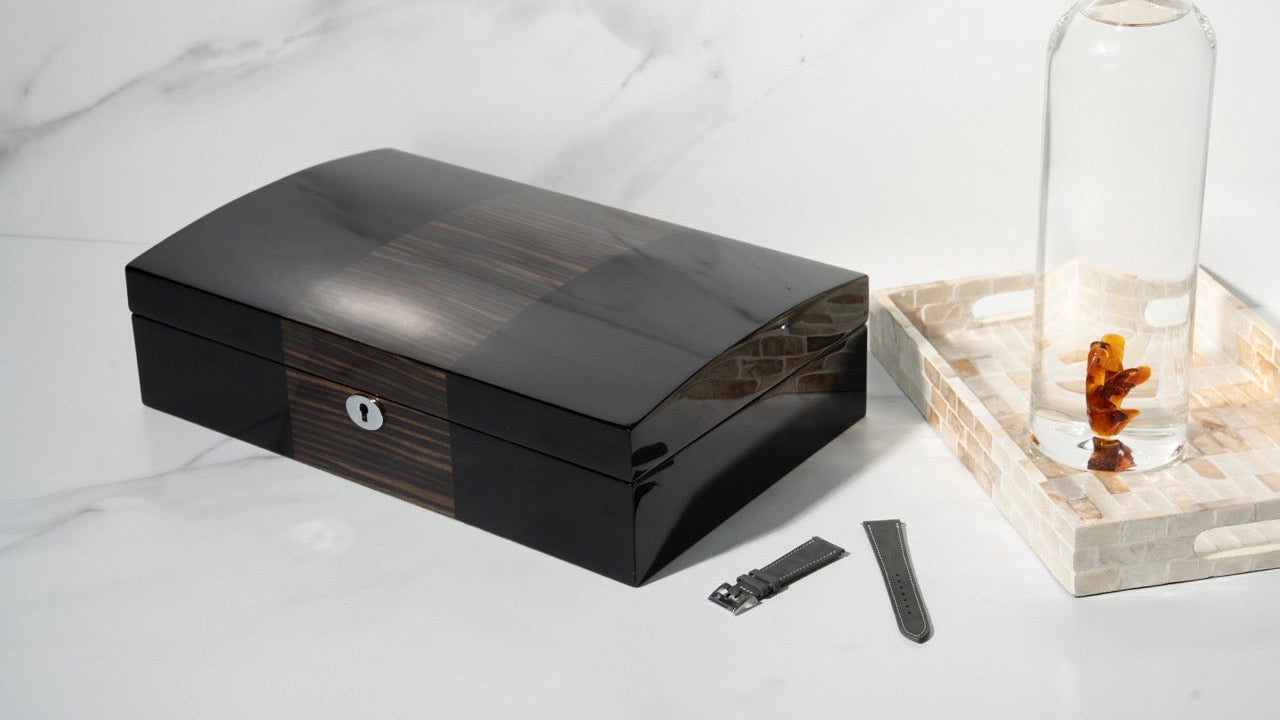
It is easy to admire the solid wood exterior of a BezelHold luxury watch box —the rich grain of the Mahogany or the sleek modernity of the Black Walnut. But the real engineering happens inside.
We didn't just choose a fabric that felt soft; we chose a material that respects the metallurgy of your collection. By understanding the Mohs scale and the mechanics of friction, we have created an environment where your watches don't just sleep—they are preserved.
Don't let invisible dust and cheap felt erode the value of your investments. Trust the science of BezelHold.


コメントを書く
このサイトはhCaptchaによって保護されており、hCaptchaプライバシーポリシーおよび利用規約が適用されます。